Double Hot jupiters through ZLK migration
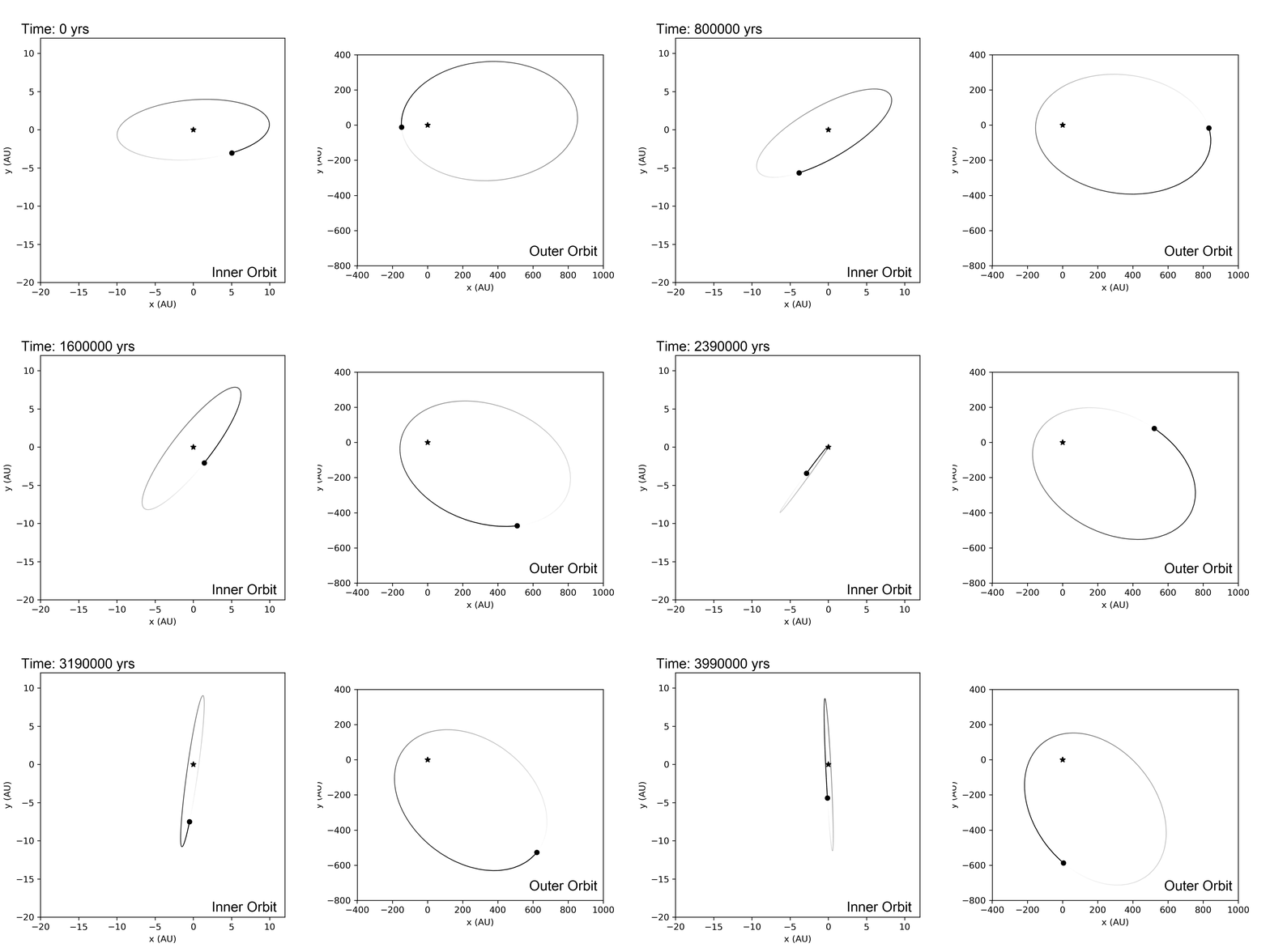
I researched the formation of double hot Jupiter systems through mirrored von Zeipel–Lidov–Kozai (ZLK) migration in stellar binaries. I ran N-body simulations using REBOUND and REBOUNDx to study how asymmetric planetary masses and mutual inclinations influence double hot Jupiter formation. I also estimated the occurrence rate of such systems from the observed distribution of Gaia binaries known to host hot Jupiters. This work provides testable predictions for identifying additional double hot Jupiter systems in future surveys. We applied this mechanism to the only known double hot Jupiter system: WASP-94.
See: Liu, Lu, & Rice 2025, Liu, Lu, & Rice 2026
Probing Gas Giant Origins: Chemistry and Isotope Ratios of Substellar Atmospheres in the β Pictoris Young Moving Group and Vicinity
I developed an atmospheric retrieval code using petitRADTRANS and PyMultiNest to analyze high-resolution CRIRES+ spectra of directly imaged substellar objects in the β Pictoris moving group. I retrieved chemical abundances and isotope ratios (C/O, [Fe/H], and 12CO/13CO) for the gas giant 2M0249-0557 c and two benchmark brown dwarfs, interpreting the results in the context of the planet's formation pathway. My analysis supports a star-like gravitational collapse origin for 2M0249-0557 c and provides a comparative baseline measurement of abundaces in the β Pictoris moving group and vicinity.
See: Liu et. al. 2026a
High-Eccentricity Migration Driven by Secular Chaos in Wide Binary Systems
I developed a novel secular integration codes in C to study secular chaos in hierarchical “3+1” quadruple exoplanet systems (planet orbiting a star, perturbed by a nearby substellar/stellar companion and a fourth distant stellar companion). I created surfaces of section from rotating frame Hamiltonian of the “3+1” quadruple system to analytically probe parameter space of chaos. I demonstrated that near-coplanar and circular “3+1” quadruple systems can excite planetary eccentricities to levels sufficient for high-eccentricity migration and found that hot Jupiters that form through this mechanism have stellar obliquity distributions centered near 90 degrees.